Overview
General Info
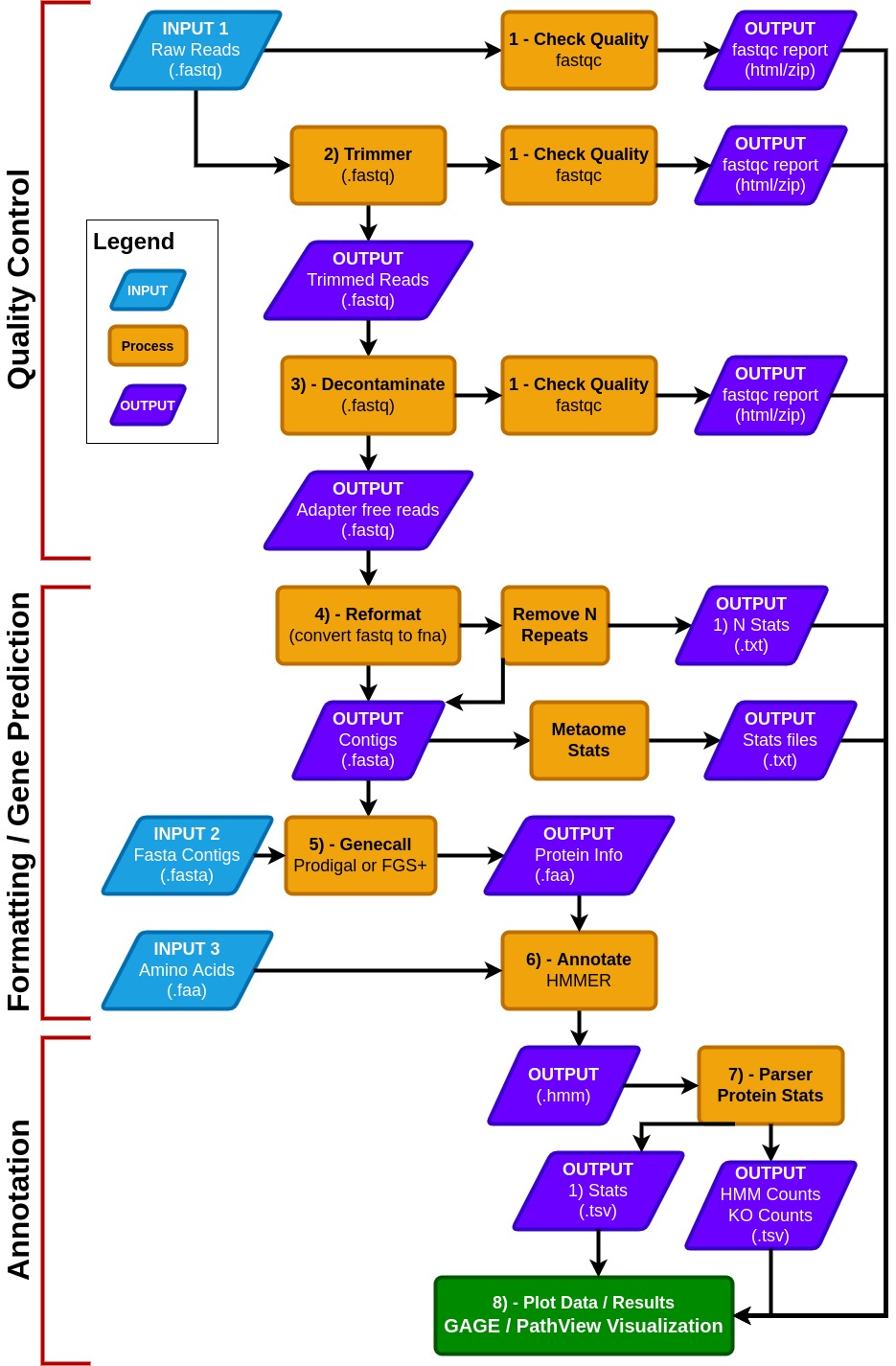
- MetaCerberus has three basic modes:
Quality Control (QC) for raw reads
Formatting/gene prediction
Annotation
- MetaCerberus can use three different input files:
Raw read data from any sequencing platform (Illumina, PacBio, or Oxford Nanopore)
Assembled contigs, as MAGs, vMAGs, isolate genomes, or a collection of contigs
Amino acid fasta (.faa), previously called pORFs
We offer customization, including running all databases together, individually or specifying select databases. For example, if a user wants to run prokaryotic or eukaryotic-specific KOfams, or an individual database alone such as dbCAN, both are easily customized within Metacerberus.
In QC mode, raw reads are quality controlled with pre- and post-trim via FastQC. Raw reads are then trimmed via data type; if the data is Illumina or PacBio, fastp is called, otherwise it assumes the data is Oxford Nanopore then PoreChop is utilized.
If Illumina reads are utilized, an optional bbmap step to remove the phiX174 genome is available or user provided contaminate genome. Phage phiX174 is a common contaminant within the Illumina platform as their library spike-in control. We highly recommend this removal if viral analysis is conducted, as it would provide false positives to ssDNA microviruses within a sample.
We include a
--skip_deconoption to skip the filtration of phiX174, which may remove common k-mers that are shared in ssDNA phages.In the formatting and gene prediction stage, contigs and genomes are checked for N repeats. These N repeats are removed by default.
We impute contig/genome statistics (e.g., N50, N90, max contig) via our custom module Metaome Stats.
Contigs can be converted to pORFs using Prodigal , FragGeneScanRs, and Prodigal-gv as specified by user preference.
Scaffold annotation is not recommended due to N’s providing ambiguous annotation.
Both Prodigal and FragGeneScanRs can be used via our
--superoption, and we recommend using FragGeneScanRs for samples rich in eukaryotes.FragGeneScanRs found more ORFs and KOs than Prodigal for a stimulated eukaryote rich metagenome. HMMER searches against the above databases via user specified bitscore and e-values or our minimum defaults (i.e., bitscore = 25, e-value = 1 x 10⁻⁹).
Input File Formats
From any NextGen sequencing technology (from Illumina, PacBio, Oxford Nanopore)
Type 1 raw reads (.fastq format)
Type 2 nucleotide fasta (.fasta, .fa, .fna, .ffn format), assembled raw reads into contigs
Type 3 protein fasta (.faa format), assembled contigs which genes are converted to amino acid sequence
Output Files
If an output directory is given, that folder will be created where all files are stored.
If no output directory is specified, the ‘results_metacerberus’ subfolder will be created in the current directory.
Gage/Pathview R analysis provided as separate scripts within R.
Visualization of Outputs
We use Plotly to visualize the data
Once the program is finished running, the html reports with the visuals will be saved to the _last_ step of the pipeline.
The HTML files require plotly.js to be present. One has been provided in the package and is saved to the report folder.